
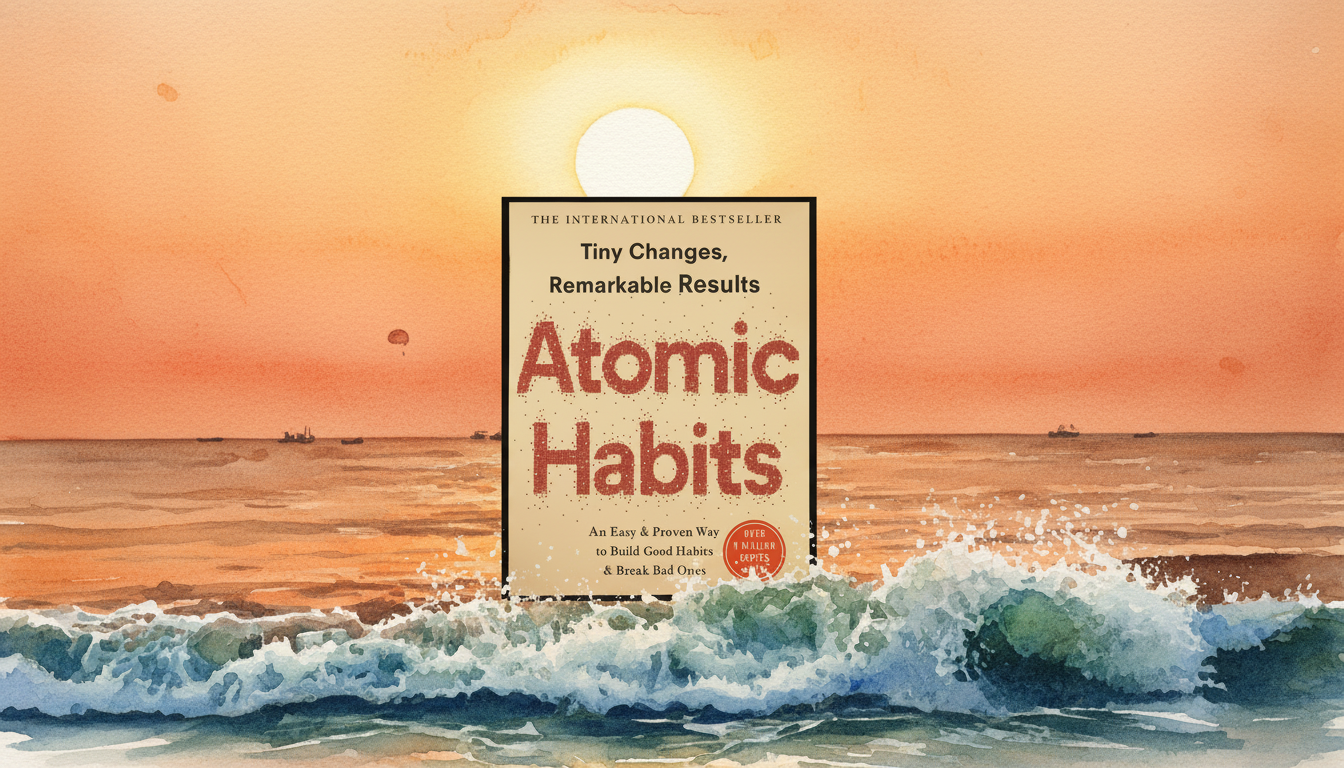
Book Name:
Atomic Habits
What Is the Book About:
Atomic Habits is a bestselling self-help book written by James Clear.
It teaches about creating good habits, changing behaviours, being productive, and growing personally. Rather than encouraging big changes in one’s life, the author demonstrates how small steps could bring great benefits. James Clear provides a proven formula for success through four core principles:
- make it obvious,
- make it attractive,
- make it easy,
- and make it satisfying.
It is about transforming your life one habit at a time.
Author:
James Clear

James Clear publishes a widely-read weekly newsletter and blog at jamesclear.com and is a sought-after speaker and consultant. His work has helped millions of people and organizations create effective systems that produce long-term results. He emphasizes small, daily improvements and popularized the idea of getting 1% better each day along with the “four laws of behavior change.” Clear blends scientific research with clear, actionable advice, using stories and simple frameworks that readers can apply immediately
One-Line Message:
Small daily habits may look unimportant, but over time they can completely change your health, mindset, success, and life.
One of the most practical and accessible books when it comes to building habits, is Atomic Habits. It can be seen as the greatest strength that this book transforms psychology into practical action. James Clear speaks in the language of an encouraging coach who explains how simple and effective creating new habits is. The examples used in the book are vivid and easy to implement in practice.Perhaps, some people will be bored because of some ideas that repeat, however, this is also beneficial, since it drives home the point.Overall, I would recommend this book to everyone who is striving to develop themselves.
Critical Review
Brief Summary
Chapter 1: The Surprising Power of Atomic Habits
Why tiny habits create big results over time
According to James Clear, you won’t see quick results from small habits, yet over time they are what bring about a great deal of change. He puts it in terms of compound interest: the modest gains add up to something major. And it works for bad habits as well; a minor error can snowball into a big problem if you let it. The point the chapter makes is that success comes from doing little things again and again rather than making one grand gesture. You could say it is the book’s most vital idea.
Chapter 2: How Your Habits Shape Your Identity
The connection between daily actions and the person you become
According to this chapter, habits are as much about the person you turn into as they are about your actions. In a sense, each thing you do is a vote for the kind of individual you wish to be. Take reading every day for instance: it cements your identity as a reader. Or regular exercise, which makes you someone who is healthy. Ultimately, if you want to alter your behavior, you have to start by changing your identity first.
Chapter 3: How to Build Better Habits in 4 Simple Steps
The simple habit loop that explains human behavior
Here the writer explains the four-step pattern of a habit: cue, craving, response and reward. In short, there is a trigger to start things off, then you have desire, action and the result that follows. When you understand this loop, habits become easier to build or break. You will find this is the basic system the author puts forward in the chapter, one that makes forming habits a simple and practical affair for the rest of the book.
Chapter 4: The Man Who Didn’t Look Right
How noticing small signals can change behavior
Habits are developed by virtue of awareness. It has been explained by the author that most of the bad habits develop subconsciously. In case you are unaware of your behavior, there will be no possibility to make changes. Habit scorecards can prove helpful for recording your actions during the day.
Chapter 5: The Best Way to Start a New Habit
How habit stacking makes new habits easier to follow
Habit stacking involves performing a new habit immediately after an older one as suggested by James Clear. For example, after brushing your teeth, you may meditate for one minute.
The technique is effective since it utilizes an already established routine as a trigger. This eliminates any confusion and makes habits more natural to be practised. This is an excellent approach towards forming habits.
Chapter 6: Motivation Is Overrated; Environment Often Matters More
Why your surroundings shape your habits more than willpower
People tend to rely too much on motivation. Actually, what affects us greatly depends on our surroundings. If there is healthy food in front of you, you will choose to eat it. If your phone is always accessible to you, then you may end up wasting your time on it. Creating a better environment will help create better habits.
Chapter 7: The Secret to Self-Control
How removing temptation helps break bad habits
This chapter highlights how self-control becomes easier if temptations are minimised. Disciplined individuals are not necessarily stronger; they simply choose to stay away from situations where they will be tempted. Rather than battling distractions all day long, eliminate them from your surroundings. Examples include removing junk food from your home or turning off alerts on your phone.
Chapter 8: How to Make a Habit Irresistible
Using attraction and pleasure to make habits stick
We repeat actions that are appealing to us. The writer introduces temptation bundling, where you pair something enjoyable with something useful. An example would be listening to your favourite music during exercise. It makes the routine fun and more sustainable. The brain goes by the rewarding path.
Chapter 9: The Role of Family and Friends in Shaping Your Habits
How social influence affects success and daily behavior
Individuals tend to adopt the behaviors of their peers. It is human nature to align ourselves with our families, friends, and peer groups. If the people in your environment read regularly, exercise, or work diligently, you are bound to follow the same. This is why having the correct environment is important for rapid development. Associating oneself with the right group of people is one of the most potent ways of achieving success.
Chapter 10: How to Find and Fix the Causes of Your Bad Habits
Understanding cravings so you can change harmful behavior
In this chapter, the cravings people have are explained to come out of underlying desires. People may not crave social media but crave interaction or entertainment in social media. It is not the junk food that someone may crave for, but they may be craving comfort and taste in the food. If you are aware of what drives the unhealthy behavior in people, then you are able to find an alternative to replace it with.
Chapter 11: Walk Slowly, but Never Backward
Why making habits easy is better than making them perfect
The writer believes that the most effective habit is one that one follows. People tend to be unsuccessful since they create very challenging habits in the beginning. It is always better to take the first step and continue doing so consistently. Even a span of two minutes can help you make progress.
Chapter 12: The Law of Least Effort
How reducing friction helps you stay consistent
The tendency is for people to pick the easiest route. Therefore, if one is hoping to form a healthy habit that will last, he should make it easy to do. He could prepare his gym dress a night before, or always have a book within arm’s reach. When wanting to break an undesirable habit, then it should be made difficult to do.
Chapter 13: How to Stop Procrastinating by Using the Two-Minute Rule
Starting small so your brain stops resisting action
James Clear explains the Two-Minute Rule: When introducing a new habit, keep it under two minutes long. “Read every night” can be reduced to “read one page.” “Go for a run” can be changed to “lace up running shoes.” It’s easier to start, and beginning is often the most difficult part. Small starts often lead to bigger action.
Chapter 14: How to Make Good Habits Inevitable and Bad Habits Impossible
Using smart systems to control future behavior
This chapter concentrates on commitment devices and systems. Commitment devices and systems are those decisions you make today to dictate your actions tomorrow. Examples include paying in advance for a course, which will make skipping it less tempting. You may lock yourself out of some applications or leave your credit card behind to avoid temptation. Strong systems reduce the need for daily self-control.
Chapter 15: The Cardinal Rule of Behavior Change
Why habits last when they feel satisfying right away
We do things that feel good and refrain from doing things that hurt.
This is the reason why instant gratification is such an effective way to form a habit. A good habit tends to yield delayed gratification, but a bad one provides instant gratification. According to James Clear, you need to include instant gratification into good habits.
Chapter 16: How to Stick with Good Habits Every Day
Tracking progress to build consistency and motivation
One of the most effective strategies is habit tracking. Once you start monitoring your habits, it becomes easy for you to notice your improvements. This will help to provide you with motivation. In addition, habit tracking gives you a sense of accomplishment when you finish a habit.
Chapter 17: How an Accountability Partner Can Change Everything
Why outside pressure can support personal discipline
Behavioral Patterns Change When They Are Monitored. An Accountability Partner Can Help You to Take Things Seriously. It may be a close friend, mentor, coach, or even your commitment to society in general. The knowledge that there will be some consequences for failure can lead to more strictness.
Chapter 18: The Truth About Talent
Choosing habits that match your strengths and personality
Individuals achieve more if their tendencies align with their natural talents. Every person is not expected to take the same route. Select objectives and processes based on your individuality, competencies, and circumstances. It gets easier to succeed if you are working in accordance with your strengths. Self-awareness leads to better habits.
Chapter 19: The Goldilocks Rule
How to stay motivated by working at the right level of challenge
As explained by James Clear, people remain motivated only if the job is neither too easy nor too difficult. This is referred to as the Goldilocks principle. If the job is too easy, it will be uninteresting. If the job is too difficult, it will be frustrating and demotivating. The right level of challenge keeps you engaged and improving.
Chapter 20: The Downside of Creating Good Habits
Why habits must still be reviewed and improved over time
Habits are powerful, but they can also make people lazy or careless. Once a habit becomes automatic, you tend to lose focus. This is why it is necessary for one to reflect. One must strive for improvement and not just repetition. Mastery comes from habits plus awareness.
Key Lessons From the Book:
- Small habits create big results when repeated consistently over time.
- Identity matters more than goals, because lasting change happens when you become the kind of person who naturally does the right things.
- Your environment shapes your behavior, so design your surroundings carefully.
- Make good habits easy and attractive if you want them to last.
- Track progress and stay accountable to build long-term discipline.
- Start tiny instead of waiting for perfect motivation.
- Real success is based on systems, not only on goals.
Who Should Read:
- Students who want better study habits
- Professionals who want more focus and productivity
- Entrepreneurs who want strong daily systems
- Content creators who want consistency in work
- Anyone trying to break bad habits and build a better lifestyle
- Readers interested in self-discipline, personal development, and long-term success
Final Thoughts:
Here is what Atomic Habits reveals: It is not necessary for you to change everything about yourself in one day; all you have to do is make gradual improvements every day. It is easy to understand and full of valuable insights about how to be successful by making efforts daily. This is definitely the book that everyone who wants to be disciplined, productive, and focused should consider reading.
The reason behind its importance for all people around the globe lies in the fact that everyone can implement good habits in their daily lives.
After all, it is not a big choice that determines the course of your life; it is little decisions made on a daily basis.