
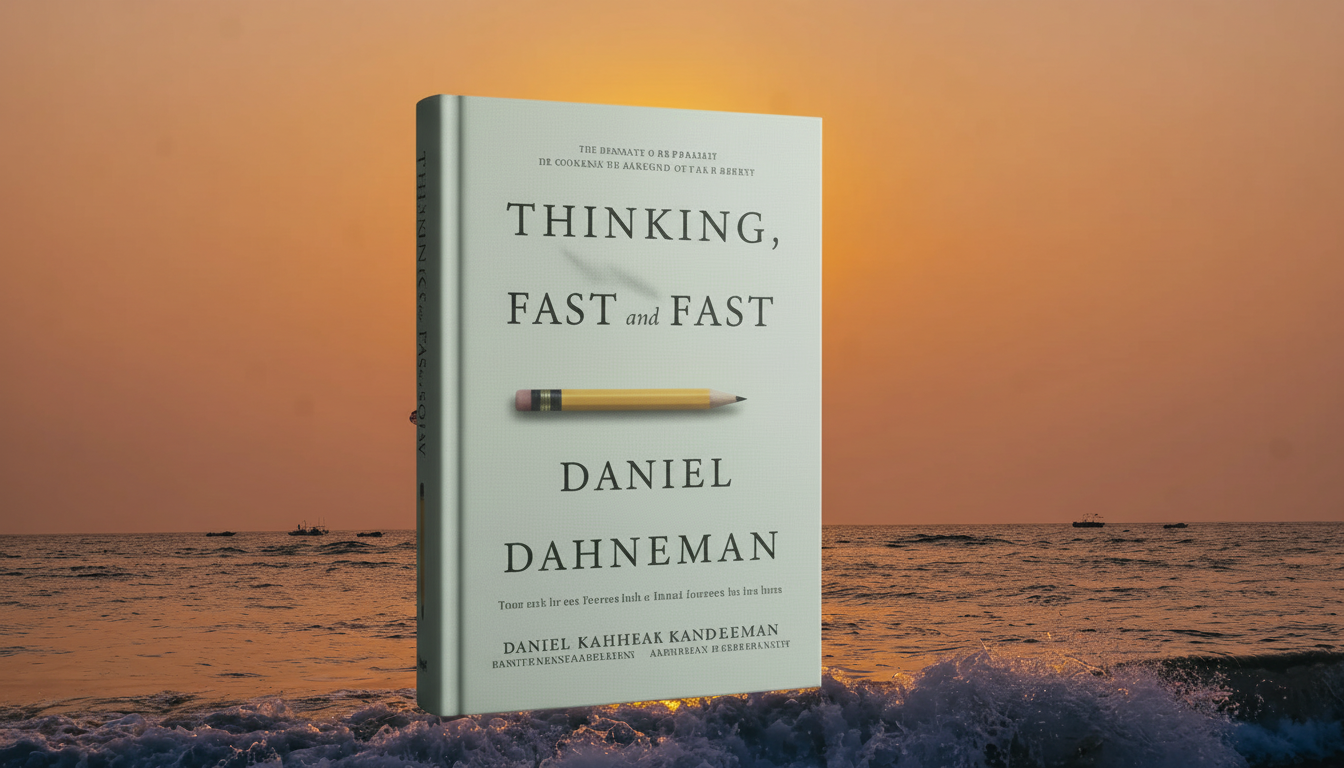
Book Name:
Thinking, Fast and Slow
Author:
Daniel Kahneman

Daniel Kahneman is an Israeli‑American psychologist and Nobel laureate celebrated for founding much of behavioral economics. Born in 1934 in Tel Aviv, he trained as a psychologist and earned his PhD from the University of California, Berkeley. Alongside his long‑time collaborator Amos Tversky, Kahneman developed prospect theory and mapped the heuristics and biases that shape everyday judgment. In 2002 he received the Nobel Prize in Economic Sciences for bringing psychological insights into economic theory. He served as a professor at Princeton University and influenced policymakers, businesses, and researchers with his work on decision-making.
What Is the Book About:
Thinking, Fast and Slow explains how two mental systems shape our judgments and choices, why we make predictable errors, and what practical steps individuals and institutions can take to improve decision-making.
Who Should Read This Book:
- Entrepreneurs, managers, and product designers
- Marketers and policy makers
- Anyone who makes frequent or high-stakes decisions
- Content creators and educators who explain human behavior
- Readers curious about why people think and choose the way they do
One-Line Message:
Learn how two ways of thinking: fast intuition (System 1) and slow reasoning (System 2), shape our choices, and use simple habits to avoid predictable mistakes
Kahneman’s book is rigorous, readable, and full of experiments that reveal human thinking patterns. Some critics note the book focuses more on errors than on when intuition works well, and a few experimental replications in psychology have prompted debate—but the core insights remain highly influential. The writing is dense in parts but full of practical value for readers who apply the lessons. Overall, it is a landmark work that balances science with everyday relevance.
Critical Review
Part I — Two Systems
Chapter 1: The Characters of the Story
Kahneman introduces two modes of thinking he calls System 1 (fast, automatic, intuitive) and System 2 (slow, deliberate, analytical). System 1 generates impressions, feelings, and intuitions almost effortlessly; System 2 monitors and can override System 1 but requires effort and attention. Much of everyday life is run by System 1 because it conserves mental energy and handles routine tasks efficiently. Kahneman stresses that these systems are complementary—strengths of one compensate for weaknesses of the other—but they also create systematic errors when System 1’s intuitions go unchecked. Understanding the interaction between the two systems is central to diagnosing common mistakes in judgment and decision-making.
Chapter 2: Attention and Effort
This chapter explains how mental effort is a limited resource and how System 2’s operations consume it. Tasks that demand concentration—complex calculations, careful reasoning, or resisting temptation—are handled by System 2 and feel effortful; when taxed, people default to easier System 1 responses. Kahneman shows that people avoid cognitive effort when possible, which explains why biases and heuristics propagate: we often take the lazy route to conclusions. He also discusses how self-control and willpower are linked to available mental resources, and how fatigue or distraction makes poor decisions more likely. Recognizing when a decision requires deliberate attention is essential to improving judgment.
Chapter 3: The Lazy Controller
Kahneman describes System 2 as the “lazy controller” that often endorses System 1’s suggestions without deeper scrutiny unless prompted. This laziness is adaptive—most of the time System 1 is accurate and speed matters—but it also leads to errors when stakes are high or situations are atypical. He illustrates how System 2’s reluctance to engage can produce overconfidence in first impressions and lead to failures of reasoning. Training habits, checklists, and decision rules are practical ways to force System 2 involvement when necessary. The chapter warns that awareness alone isn’t enough; designing environments that trigger System 2 when needed is often required.
Chapter 4: The Associative Machine
System 1 works through associative memory: ideas, images, and feelings activate related thoughts automatically. This associative process makes impressions seem coherent and immediate but can produce false connections and narrative biases. The human mind prefers causal stories and coherence, often creating post-hoc explanations that feel right even when they’re not. Kahneman emphasizes that many judgments are driven by these associations rather than careful analysis, which explains phenomena like halo effects and stereotype-based inferences. Being aware of associative instincts helps identify when impressions are constructed rather than verified.
Chapter 5: Cognitive Ease
Cognitive ease refers to how comfortably information is processed; familiar or fluent information produces positive feelings and is more readily believed. Factors like repetition, clear font, or simple language increase cognitive ease and can bias us toward acceptance. The opposite state—cognitive strain—signals the need for System 2 engagement and often prompts more careful thinking. Kahneman shows that marketers, politicians, and communicators exploit fluency to persuade audiences, and that mere exposure can unduly increase credibility. The chapter underscores the practical value of designing messages and decisions to account for the psychology of fluency.
Part II — Heuristics and Biases
Chapter 6: Norms, Surprises, and Causes
This chapter explores how people create mental models and expect norms, so surprises or deviations trigger causal searching by System 1. When events deviate from norm, we instinctively look for causes and explanations, often preferring simple causal stories over statistical reasoning. People underuse base rates and over-attribute causality to salient events, leading to attribution errors and the illusion of control. Kahneman stresses that statistical thinking is frequently counterintuitive and easily displaced by compelling narratives. Learning to prefer data and variance-aware reasoning reduces error in complex domains.
Chapter 7: A Machine for Jumping to Conclusions
Kahneman shows how System 1 jumps to beliefs and forms coherent stories with limited evidence. He explains representative heuristics—judging probability by similarity rather than by statistical base rates—and how these lead to predictable mistakes. Quick judgments can be useful but are particularly dangerous in rare or atypical situations where sample sizes are small. The chapter highlights classic cognitive experiments demonstrating systematic departures from normative probabilistic thinking. The remedy is not to distrust intuition altogether but to know its limits and apply deliberate checks.
Chapter 8: How Judgments Happen
This chapter digs into specific mental shortcuts people use when evaluating likelihoods and making judgments. Kahneman explains substitution—when faced with a hard question, people answer an easier one unconsciously—and shows how affect and accessibility shape responses. He covers the roles of priming, anchoring, and availability in skewing perceived frequencies and risks. The chapter emphasizes that many biases are automatic outcomes of mental shortcuts that once served adaptive functions but misfire in modern contexts. Understanding the mechanisms gives readers tools to detect when judgments may be unreliable.
Chapter 9: Answering an Easier Question
The book describes how complicated assessments are often replaced by simpler, related questions without conscious awareness. For example, instead of evaluating long-term probabilities, people rely on the vividness or emotional impact of anecdotes. This substitution explains why sensational stories drive perceptions of risk and why people misjudge probabilities of rare events. Kahneman recommends structured question framing and statistical prompts to counter substitution errors. Training to reframe questions deliberately shifts decisions from heuristic-driven to analysis-driven.
Chapter 10: The Law of Small Numbers and Anchoring
Kahneman reviews how people misinterpret small samples, expecting small-population behavior to mimic large-population norms, which causes overconfidence in limited data. He also discusses anchoring—how arbitrary initial values influence numerical estimates—and shows that even irrelevant anchors systematically bias judgments. Both effects reveal people’s tendency to underweight uncertainty and overweight salient cues. Defensive strategies include insisting on larger sample sizes, running simple variance checks, and deliberately shifting anchors by considering opposite scenarios. These corrections are practical in forecasting, hiring, and strategy.
Part III — Overconfidence
Chapter 11: The Illusion of Understanding
Here Kahneman explains that coherent narratives create an illusion of explanatory depth—people feel they understand complex events better than they actually do. Hindsight bias and overfitting of stories to facts make history seem inevitable, reducing appreciation of uncertainty. Experts often construct plausible stories that hide the role of luck and unforeseen factors. The chapter suggests humility: accept the limits of prediction and focus on probabilistic thinking rather than neat narratives. Adopting probabilistic models and acknowledging ignorance improves decision quality.
Chapter 12: The Illusion of Validity and Intuition
Kahneman explores when intuition is valid—mainly in stable environments with immediate feedback—and when it’s dangerously misleading. Many expert judgments lack the conditions for reliable intuition, but people still trust them due to coherence and confidence. He contrasts genuine expert intuition (chess masters, firefighters) with weak intuitive judgments in fields lacking clear feedback (stock picking, clinical prediction). The takeaway is to test intuition against data and to prefer simple algorithms where possible. Institutionalizing checks and decision rules can curb overconfidence.
Chapter 13: Taming Intuitive Predictions
This chapter advocates combining intuition with statistical models: even simple algorithms often outperform unaided human judgment. Kahneman explains regression to the mean and how failing to account for it causes over-optimistic forecasts. He recommends “noise reduction” methods—use base rates, adjust for regression, and formalize judgment—to improve predictions. The focus is practical: create structured forecasting processes and compare human forecasts against models. Embracing such procedures increases accuracy and reduces costly errors in business and policy.
Chapter 14: Choices and Framing
Kahneman introduces prospect theory concepts that explain how people value gains and losses differently, and how framing affects choices. People exhibit loss aversion—losses hurt more than equivalent gains feel good—leading to risk-averse behavior in the domain of gains and risk-seeking in losses. Framing identical outcomes as gains or losses dramatically changes decisions, revealing inconsistency in preferences. Understanding these behavioral regularities helps design better choices in finance, negotiation, and public policy. The chapter underscores that rational-choice models must be adjusted to reflect human psychology.
Part IV — Choices
Chapter 15: Risk, Prospect Theory, and Decision Weights
This chapter lays out prospect theory’s key features: reference dependence, diminishing sensitivity, and decision weights that depart from objective probabilities. Outcomes are evaluated relative to a reference point, and subjective weighting of probabilities explains why people overreact to small probabilities and underreact to moderate ones. Kahneman shows how insurance purchase, gambling, and investment behavior fit this framework. The chapter has direct implications for marketing and regulation, especially when designing choices for consumers. Practical tools include reframing options and clarifying probabilities to reduce systematic misjudgment.
Chapter 16: The Endowment Effect and Mental Accounting
Kahneman discusses how ownership increases valuation (endowment effect) and how people mentally segregate or combine gains and losses in biased ways. Mental accounting causes decisions that violate economic rationality—such as treating windfall gains differently from earned income. These patterns shape consumer behavior, saving, and investing choices in predictable ways. Recognizing mental accounting can inform product design, pricing, and personal finance strategies. Nudges that simplify accounts and frame choices differently can lead to better consumer outcomes.
Chapter 17: Bad Events, Overweighting, and Insurance
People systematically overweight small-probability but salient risks and underweight common risks, which explains both excessive fear and neglect in different domains. Kahneman ties emotional salience to decision weights and discusses how fear and vividness distort rational assessment of danger. He also explores societal and policy implications, including how people respond to rare catastrophes versus chronic problems. Corrective approaches include transparent risk communication and decision aids that contextualize probabilities. Policymakers and leaders must balance emotional reactions with statistical reality.
Chapter 18: Choices — Practical Implications
This chapter synthesizes prior insights into practical guidance for decision-making contexts—business, health, and public policy. Kahneman emphasizes designing choice environments (choice architecture) that help people make decisions aligned with their long-term goals. He underscores the power of defaults, clear probability presentation, and simplified options to reduce cognitive load and error. The chapter recommends piloting interventions and measuring outcomes rather than assuming intuitions about what helps people. Iterative testing and behavioral insight improve policy and organizational choices.
Part V — Two Selves
Chapter 19: Two Selves — Experienced vs Remembering Self
Kahneman distinguishes between the experiencing self (lives through moments) and the remembering self (creates the story of experience), pointing out they evaluate happiness differently. Decisions are often made to satisfy the remembering self—which values memorable peaks and endings—rather than to maximize moment-by-moment wellbeing. This distinction explains why people choose vacations or medical treatments based on remembered narratives instead of total experienced pleasure. Kahneman shows measurement issues for welfare economics and highlights that policies must account for both selves. Understanding this split can improve personal choices about time, money, and life events.
Chapter 20: Life as a Story and the Practical Conclusion
In the final chapter, Kahneman summarizes implications: we need humility about intuition, reliance on statistical thinking, and better decision systems that combine human judgment with algorithms. He calls for institutions to test and measure outcomes, to use simple rules where appropriate, and to design environments that reduce bias. The book closes with a plea for awareness: recognizing the two systems and the two selves empowers better personal and institutional decisions. Kahneman’s work invites readers to adopt concrete practices—journaling mistakes, using checklists, and applying simple models—to improve long-term choices. The practical conclusion is optimism grounded in realistic tools for better thinking.
Most Impactful Takeaways
- Two systems framework: Know when you’re using System 1 vs System 2; slow down important decisions.
- Heuristics are predictable: Anchoring, availability, and representativeness systematically distort judgment—use checklists and data to counter them.
- Substitution and framing: People substitute easier questions and respond strongly to frames; reframe problems and ask analytic questions deliberately.
- Overconfidence is common: Prefer simple algorithms and base rates over confident expert narratives when possible.
- Prospect theory & loss aversion: Losses loom larger than gains—structure choices and incentives with that in mind.
- Use statistical thinking: Value of larger samples, regression to the mean, and probabilistic forecasts will improve decisions.
- Design choice environments: Defaults, clear options, and simplified information reduce cognitive errors and improve outcomes.
- Remember two selves: Align life decisions considering both moment-to-moment wellbeing and remembered satisfaction.
- Practical tools: Journaling decisions, pre-mortems, reference class forecasting, and simple algorithms increase accuracy.
- Institutional change matters: Systemic safeguards (test, measure, iterate) outperform reliance on individual willpower or intuition.
Is it Worthy to Archive:
Yes. This book is timeless for anyone interested in human behavior, decision-making, and applied psychology. Keep it in your reference library to revisit when designing choices or reflecting on important decisions.
Final Thoughts:
Thinking, Fast and Slow is a must-read guide to understanding your own mind and improving choices. Start by using one habit from the book—like a pre-mortem or a decision checklist—and build from there. Share simple examples in your content to help followers spot biases in real life and become better decision-makers

1 comment
[…] Neither ignorance nor indolence is behind that phenomenon. The answer is psychology. […]