
We have all been there. You launch your business, and the early days are a blur of adrenaline. You get your first 100 customers, your revenue hits six figures, and you feel unstoppable.
But then, you hit a wall.
Suddenly, doing more work doesn’t lead to more growth. It just leads to more stress. You are working harder than ever—14 hour days, missed weekends—but your bank account isn’t reflecting that effort.
If this sounds familiar, you aren’t failing. You are just stuck in the “Scaling Gap.”
Based on the latest insights from top business journals like Harvard Business Review and Forbes, most businesses don’t die because of a lack of product demand. They die because they break under their own weight when they try to grow.
Here are the three advanced mistakes that are likely stopping your business from scaling right now, and exactly how to fix them.
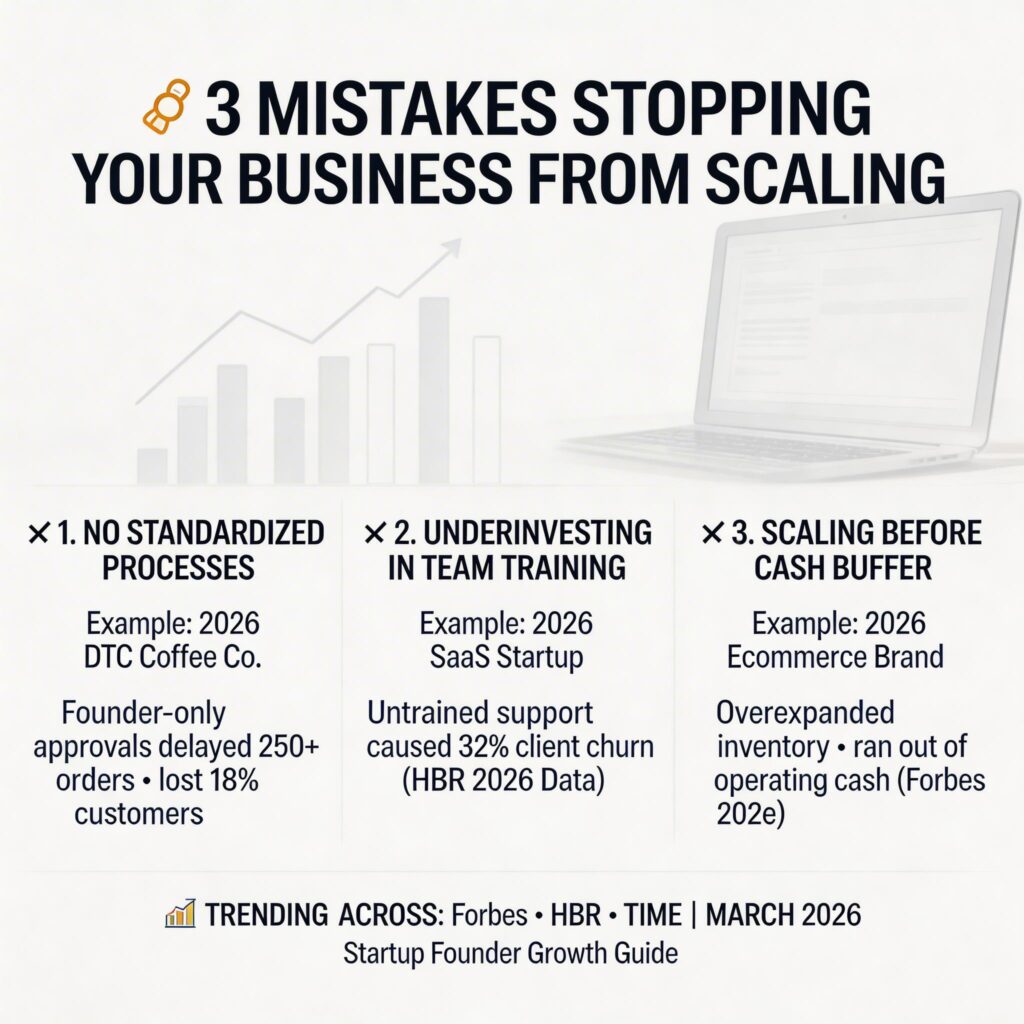
Mistake #1: You Are Addicted to “Hero Mode”
The Problem: In the startup phase, you were the hero. You did the sales, wrote the code, packed the boxes, and answered the support tickets. It worked because you are talented.
But here is the harsh truth: You cannot scale yourself.
Many founders I talk to in the US, India, and the UK suffer from the “I’ll just do it myself” syndrome. They think, “It takes me 5 minutes to do this, but 30 minutes to explain it to someone else.”
Real-World Scenario: Imagine Raj, who runs a digital marketing agency in Bangalore. He creates incredible strategies for his clients. But he insists on personally approving every single social media post because he wants them to be perfect.
- The Result: When he gets his 10th client, he becomes the bottleneck. Clients start complaining about delays. He can’t take on client #11 because he has no time left.
The Fix: Build “Boring” Systems Scaling requires your business to be boringly predictable.
- Stop being the Hero. Start being the Architect.
- Document everything. Record a 5-minute video of yourself doing a task. Give that video to a freelancer or employee.
- The Rule: If you have to do a task more than three times, automate it or delegate it.
Mistake #2: Confusing Revenue with Growth
The Problem: “We hit $$1 Million in revenue!” sounds great at a cocktail party. But how much of that did you keep?
Scaling requires cash, not just sales. A common mistake in 2026 is growing “top-line” revenue while ignoring “bottom-line” profit. If your costs grow as fast as your sales, you aren’t scaling—you are just bloating.
Real-World Scenario: Consider Sarah, who runs an e-commerce fashion brand in Canada. To scale, she spent heavily on ads and offered free shipping worldwide to get more orders.
- The Result: Her sales doubled! But her shipping costs tripled, and her ad spend ate up her margins. She was processing 500 orders a day but losing $$2 on every order. She nearly went bankrupt while looking “successful” on Instagram.
The Fix: Obsess Over Unit Economics Before you push the gas pedal, check the engine.
- Calculate your CAC (Customer Acquisition Cost). How much does it really cost to buy a customer?
- Check your LTV (Lifetime Value). How much do they spend over time?
- The Rule: If your LTV isn’t at least 3x your CAC, stop scaling. Fix your product pricing or retention first. Profit gives you the runway to scale; revenue is just vanity.
Mistake #3: Hiring “Doers” Instead of “Leaders”
The Problem: When you are small, you hire junior people—interns, assistants, junior devs—because they are affordable. You tell them what to do, and they do it.
But when you scale, you don’t have time to tell everyone what to do. If you have 20 people waiting for your instructions every morning, your business will grind to a halt.
Real-World Scenario: Liam owns a software company in the UK. He has a team of 15 hard-working junior developers. But every time a complex problem comes up, they all look at Liam. He is essentially a “Super-Manager” babysitting 15 people.
- The Result: Liam can’t focus on strategy or partnerships because he is too busy putting out fires for his team.
The Fix: Hire People Who Are Better Than You To scale, you need to hire people who tell you what to do in their area of expertise.
- Don’t just hire a marketing assistant; hire a Marketing Manager who builds the strategy for you.
- Yes, they cost more. But one leader who can manage a team of five is worth more than five cheap employees who need your constant supervision.
The Bottom Line: Growth is Uncomfortable
Scaling is painful. It requires you to break the very processes that got you to where you are today.
You have to stop being the “doer” and start being the “designer” of your business. You have to say no to unprofitable revenue. You have to trust others to make decisions.